
When One Pro Is Worth Ten Cons
Stop listing options and start making arguments


Hello friends. Nate Meyvis captured what I was trying to say better than I did:
Very often, the best choice is so much better that it makes competing options effectively irrelevant.
His full post here: https://www.natemeyvis.com/matthew-hawthorne-on-tradeoffs/
This was in response to my recent post about why I’ve stopped framing technical decisions as tradeoffs:
Below are a few other reactions worth mentioning.
Random Hacker News patron
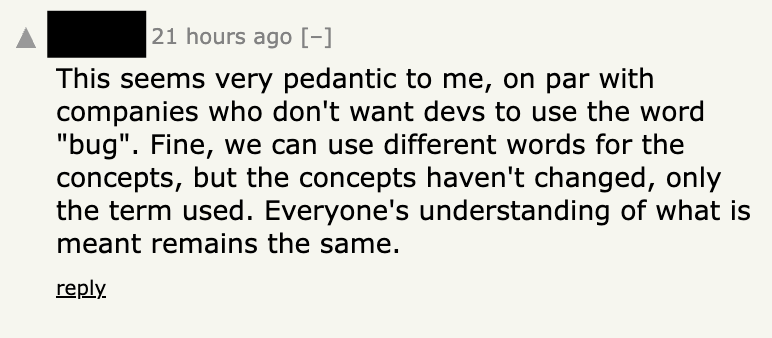
Pedantic or not, my argument definitely is not that you should frame your technical arguments around tradeoffs, but to call it something else instead.
Instead, I am saying that you should identify your goal, then illustrate how your preferred solution brings you closer to that goal.
It seems obvious. But I’ve seen it happen so rarely that it must not be.
Rands Leadership Slack
My description when sharing the link was this:
Wrote a post about why I’ve stopped saying “tradeoffs” - the framing treats every pro and con as equal in amplitude, when one pro can be worth ten cons
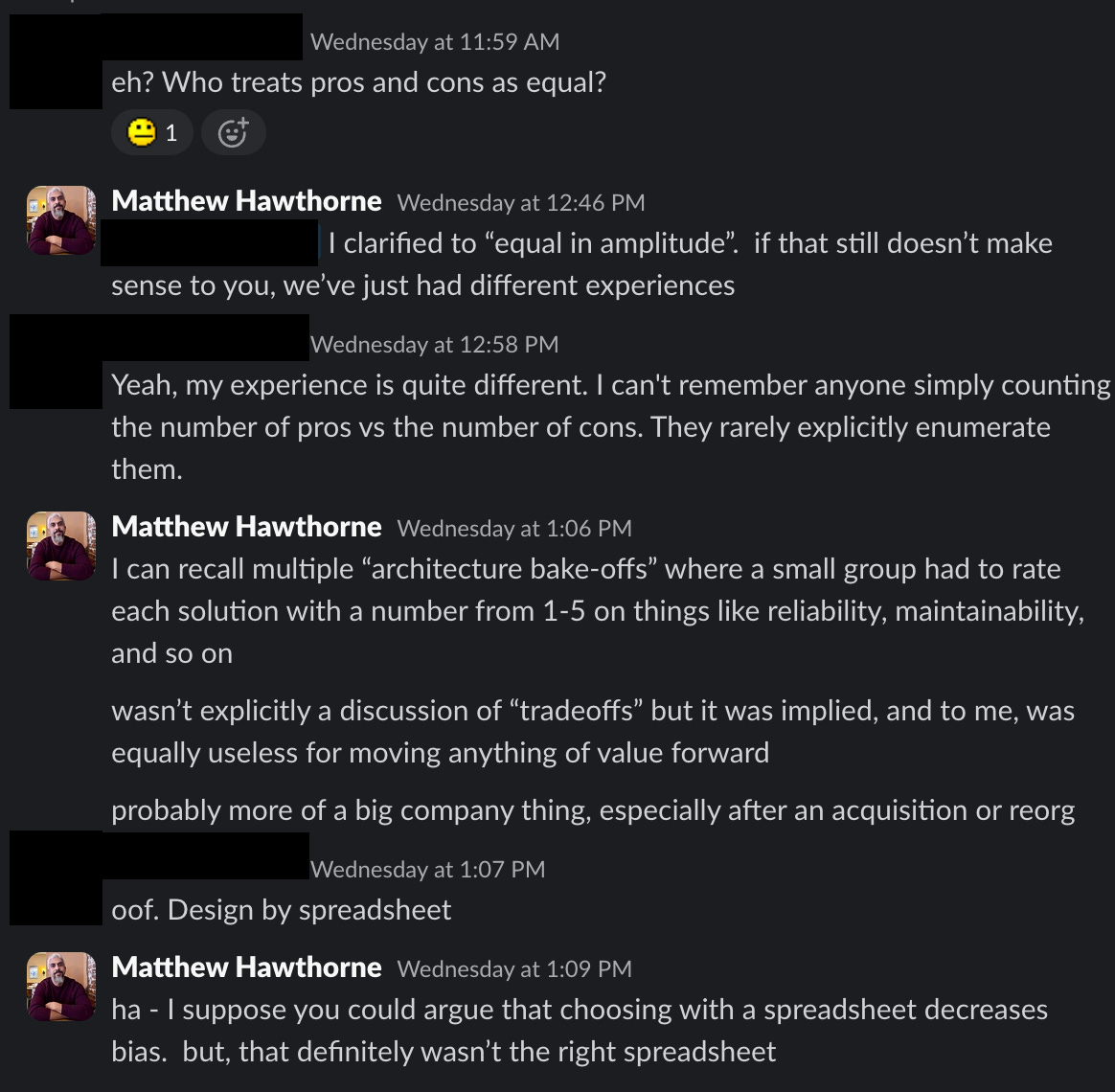
As my screenshot here implies, I often forget and am reminded of the fact that we’re all having very different experiences working in this industry.
At this point, I haven’t seen it all, but I’ve seen a lot: corporate civil wars, battles and/or border disputes, terrible proposals approved, great proposals ignored, lots of good and bad software written, plus good and bad decisions made.
If someone is describing a decision at their company that doesn’t make sense to you, try to suspend your disbelief — I guarantee it made sense to someone, at some point, for some reason.
As I mentioned, I’ve seen multiple occasions of something like this:
We’ve got 3 competing solutions. Let’s rank all of them from 1-5 on reliability, maintainability, latency, and development speed, and then choose the winner.
As the Slack responder said, this is “design by spreadsheet”, which is just a special case of design by committee, which always delivers mediocrity, at best. Every project needs a leader. Speaking of which…
A List of Options is Not a Plan
In a past job, my team was dealing with an intermittent production issue. It became less intermittent over time, so much so that we decided we needed to “do something.”
The engineers on the team had a 1-hour meeting to discuss options. I then spent 1 hour documenting those options as a phased timeline.
My manager read the document and responded:
You just wrote lists of bullet points for other people to make sense of.
He was among the worst managers I’ve ever had, but his point had merit. Writing a list of options is very different from writing:
Here is what I believe our next step should be, and why.
The primary reason my document lacked this clarity is that I hadn’t taken the time to add it yet. But the point stands. You really can learn something from anyone.
I’ve worked at companies with lots of decisions and no data, and others with lots of data and no explicit decisions. There are many more words I’ll say about this on another day. For now, I’ll say that framing arguments around tradeoffs is just one manifestation of a broader tendency to avoid taking a clear position and flooding the zone with noise disguised as information.
Thanks for reading, and have a wonderful day.

If you enjoy reading about data, decisions, persuasion, and making technical "tradeoffs" at companies like Netflix and Twitter, you'll also enjoy my book:
Push To Prod Or Die Trying: High-Scale Systems, Production Incidents, and Big Tech Chaos